
A retiree with a $3,000-a-month pension often sleeps better than a neighbor with $900,000 in the bank and no pension, even though the 4% rule says the two are worth about the same. A guaranteed paycheck gives you permission to spend. A balance you are afraid to touch does not.
Most of us will not get a pension, and Social Security rarely covers everything. But you can build the same thing for yourself. Here is how.
Floor first, then spend
Start with a number: what it would take to live comfortably each year, the life you actually want, not just the bare essentials. That number is your floor. Secure it with income you can count on (Social Security, a pension, bonds, an annuity), and you have built yourself a paycheck for life. Whatever you want to spend on top, the dream trip, the splurge, comes from your portfolio, where a strong market adds to it and a weak one only trims it.
Once the life you want is the part that is guaranteed, a down market stops being a threat to how you live. It can touch the extras, never the living you count on. That is what it means to spend without flinching.
Where the income comes from
Some of that floor you may already have. Social Security is the base most people start from, though it may not hold at today's levels. A pension too, if you are one of the few who still gets one. Your portfolio can chip in too, through dividends, though those are income you hope for rather than income you can count on, since a company can cut its dividend in a bad year. For a floor, you want the part you can count on.
Beyond what you already have, there are two ways to manufacture more, and this is the real decision. You can build it yourself with a bond ladder: bonds that mature in a staircase, one each year, so a predictable amount lands in your account as each one comes due. Or you can buy it with a fixed income annuity: you hand an insurer a lump sum, and they send you a guaranteed check for the rest of your life. Both give you a floor. They just pay for it in different ways, and the honest way to compare starts with a number almost nobody looks at.
Is the annuity a good deal?
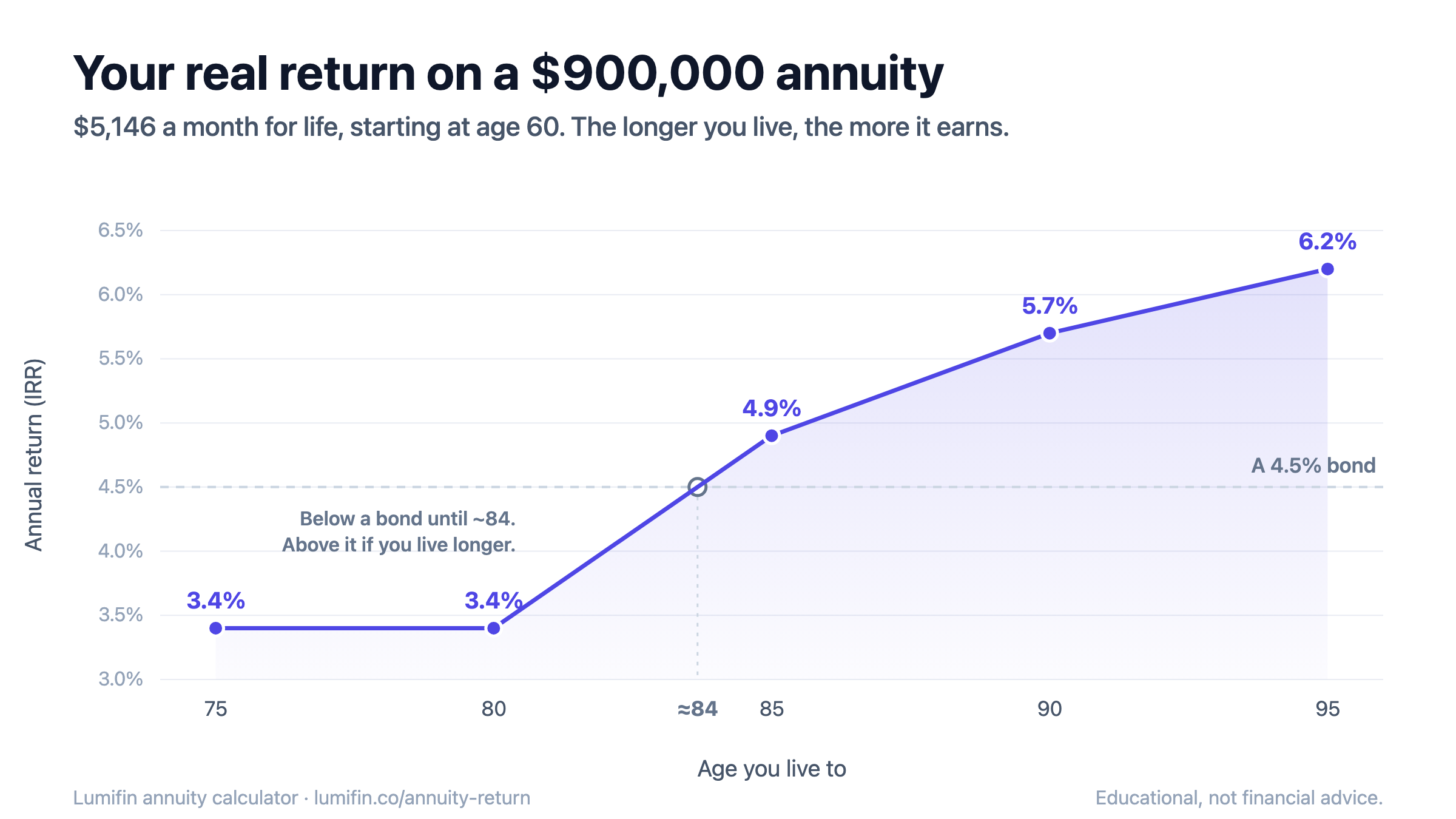
When an insurer offers you $5,146 a month for life on a $900,000 premium, whether it is a good deal comes down to one thing you cannot know in advance: how long you live. I ran that exact quote through our free annuity calculator, and here is what it shows.
| If you live to… | Your real return |
|---|---|
| 80 | 3.4% a year |
| 85 | 4.9% a year |
| 90 | 5.7% a year |
| 95 | 6.2% a year |
Live to 80 and the annuity earned you about 3.4% a year, a little less than a good bond pays today. The longer you live past that, the better it gets: 5.7% a year if you reach 90, 6.2% if you reach 95. Set against a plain 4.5% bond, the annuity comes out ahead on rate if you live past about 84, which is right around a 60-year-old's life expectancy.
That crossover is how you compare the two: find the age where the annuity's return catches the bond's yield, then ask whether you expect to live past it.
But return is the wrong lens. A bond ladder can run out; an annuity cannot, and it is worth the most in exactly the case your portfolio handles worst, which is you living a very long time. You are not buying a great return. You are buying insurance against outliving your money. Judge it by that, not by its IRR.
(One note on that $5,146. It is a level payout, the same check every month for life. You can also buy a version that rises about 2% a year to keep up with inflation, which starts lower, around $4,216 a month. Same $900,000, just a flat check or a growing one. The calculator compares level payouts, so that is the figure I used here.)
You do not have to choose
The two tools are good at opposite things. A bond ladder is liquid, finite, and perfect for a need with a known end date. An annuity is locked, lifelong, and perfect for a need with no end date, which is the rest of your life.
So pair them. Use a bond ladder to cover the near years, the bridge from the day you retire until your Social Security starts. Then let an income annuity, funded from your tax-deferred account and starting at 60, carry the lifetime floor from there. Bonds for the years you can count, an annuity for the years you cannot.
One detail worth getting right if you retire early: money pulled from a tax-deferred account before 59½ usually costs a 10% penalty, so the bridge is cleanest funded from taxable savings. An annuity that starts paying at 60 is already past that line, so it sidesteps the penalty on its own.
There is an upside to funding the annuity from that tax-deferred account, too. Moving the money into the annuity is not a taxable event, and you pay ordinary income tax on the checks only as they arrive, the same tax that money owed on its way out anyway. So you turn a balance you would have drawn down and been taxed on into a guaranteed paycheck for life, with no lump-sum tax bill to get there.
The takeaway
Secure the floor, and the rest of your money finally becomes spendable. That is the whole game. Not the highest ending balance, but the confidence to enjoy what you have.
If you are weighing a real quote, or you just want to feel the trade-off, the annuity calculator is free. And when you want to size that floor against your actual accounts and income, that is what Lumifin is for.
Educational only, not financial or tax advice, and not a recommendation to buy an annuity. Everyone's situation is different. Model your own numbers, or check with a fiduciary advisor or CPA, before acting.